
The Eichler Fireplace: What a Flat Roof Does to a Chimney
Sunnyvale and Mountain View’s Eichler tracts pair a flat roof with a distinctive atrium fireplace — what that means for sweeping and flashing.
Published
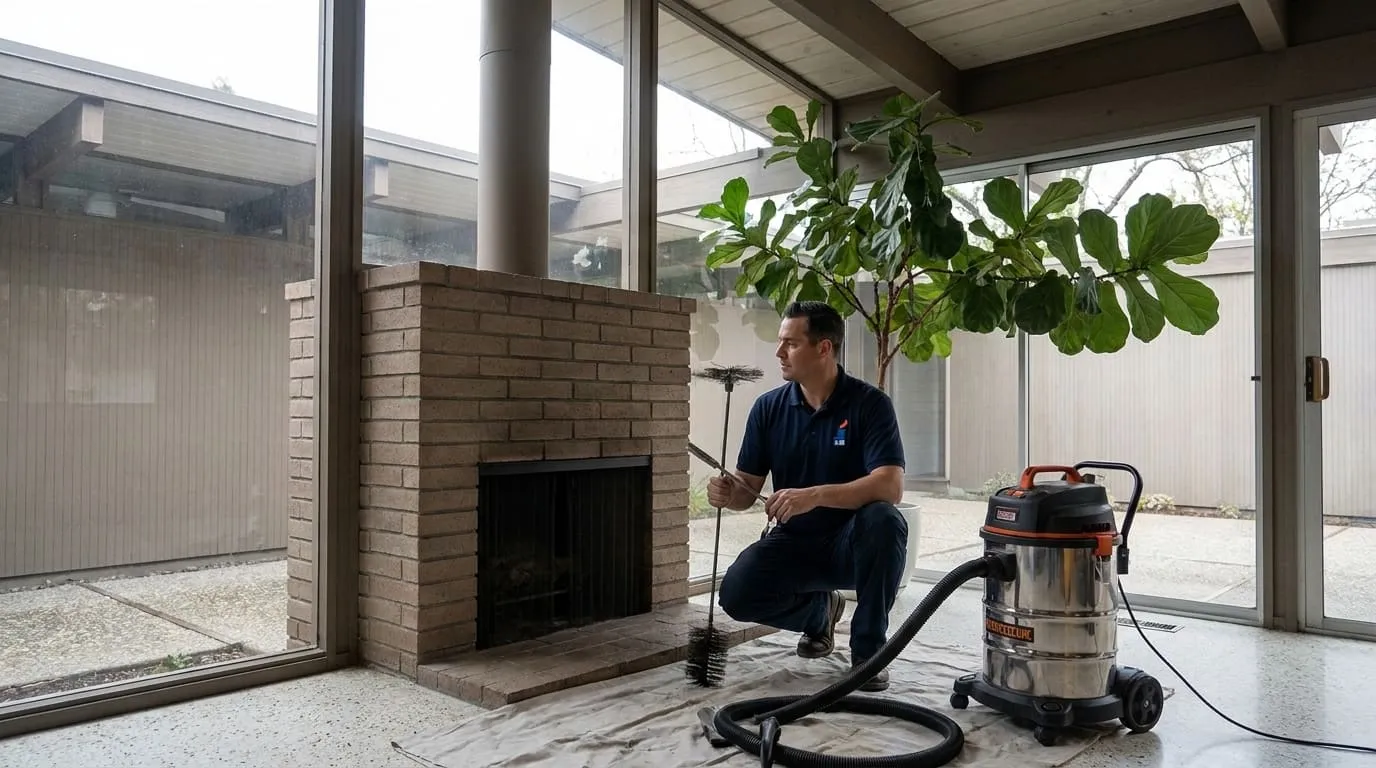
An Eichler home’s post-and-beam construction, flat roof and radiant in-slab heat come with a fireplace and flue unlike almost anything else in the Santa Clara Valley. The flat-roof penetration, not the crown, is usually where the real risk sits.
If you own a home in one of Sunnyvale’s Fairbrae or Birchwood tracts, or Mountain View’s Monta Loma and Waverly Park neighborhoods, there is a decent chance you own an Eichler: one of the roughly 11,000 homes Joseph Eichler’s company built across California between 1949 and 1966, several thousand of them concentrated right here in the Santa Clara Valley. They are architecturally distinctive: post-and-beam construction, floor-to-ceiling glass facing an interior atrium, a low-pitched or genuinely flat roof, and radiant heat run through pipes embedded in the concrete slab floor rather than forced-air ducting. The fireplace that comes with that package is just as distinctive, and it needs a different eye than a conventional pitched-roof brick chimney does.
A slimmer, often single-wall flue
Many Eichler fireplaces run a narrower flue than a standard masonry chimney, sometimes single-wall metal rather than a full clay-tile-lined masonry shaft, built to fit the home’s low-profile roofline without the tall, prominent stack a conventional house would have. That narrower passage still accumulates creosote from regular use, and it still needs an annual sweep. The brushing technique adjusts for the tighter diameter, but the underlying maintenance need does not go away just because the flue is smaller.
Where the real risk actually sits: the roof penetration
On a pitched-roof chimney, the crown and the mortar joints take the brunt of weather exposure. An Eichler’s flat or near-flat roof changes that equation. Water does not shed off a flat roof the way it does off a steep pitch; it sits, however briefly, and any point where a roof surface is penetrated by something else, a chimney flue included, is a place standing water can find its way in if the flashing and sealant around that penetration are not doing their job. A crown crack matters less on an Eichler’s shorter, often metal-flue system than a compromised flat-roof penetration does, and that is exactly the detail a generic pitched-roof inspection checklist can miss if the technician does not know to look for it specifically.
Radiant heat and the atrium fireplace as a design centerpiece
Because Eichler homes were built without forced-air ductwork in many original configurations, the fireplace often served as a genuinely functional secondary heat source rather than a decorative feature, which means many of these fireplaces have seen real regular use over the decades, not the occasional-fire pattern common in a more conventional living room. The atrium placement, with the fireplace often visible from multiple rooms through the home’s signature glass walls, also means soot staining or a smoky smell is more noticeable here than it would be in a house where the fireplace sits in an enclosed den.
What we check differently on an Eichler visit
A sweep on an Eichler fireplace follows the same core sequence as any other (protect, brush, extract, inspect), but the inspection afterward puts extra attention on the flat-roof flashing and penetration seal rather than assuming a crown-and-mortar-first approach. We also confirm flue clearances specific to the home’s post-and-beam construction, since Eichler framing details do not always match a standard code-minimum assumption from a more conventional build.
Read next
More from the blog
Get a written scope, not a guess
We inspect first and put the repair in writing, with photos, and never give a number sight unseen.