
Diablo Wind Season and What It Means for Your Chimney
Fall’s dry, offshore Diablo winds raise wildfire risk across the Santa Clara Valley. Here is what that means for your chimney’s spark arrestor, specifically.
Published
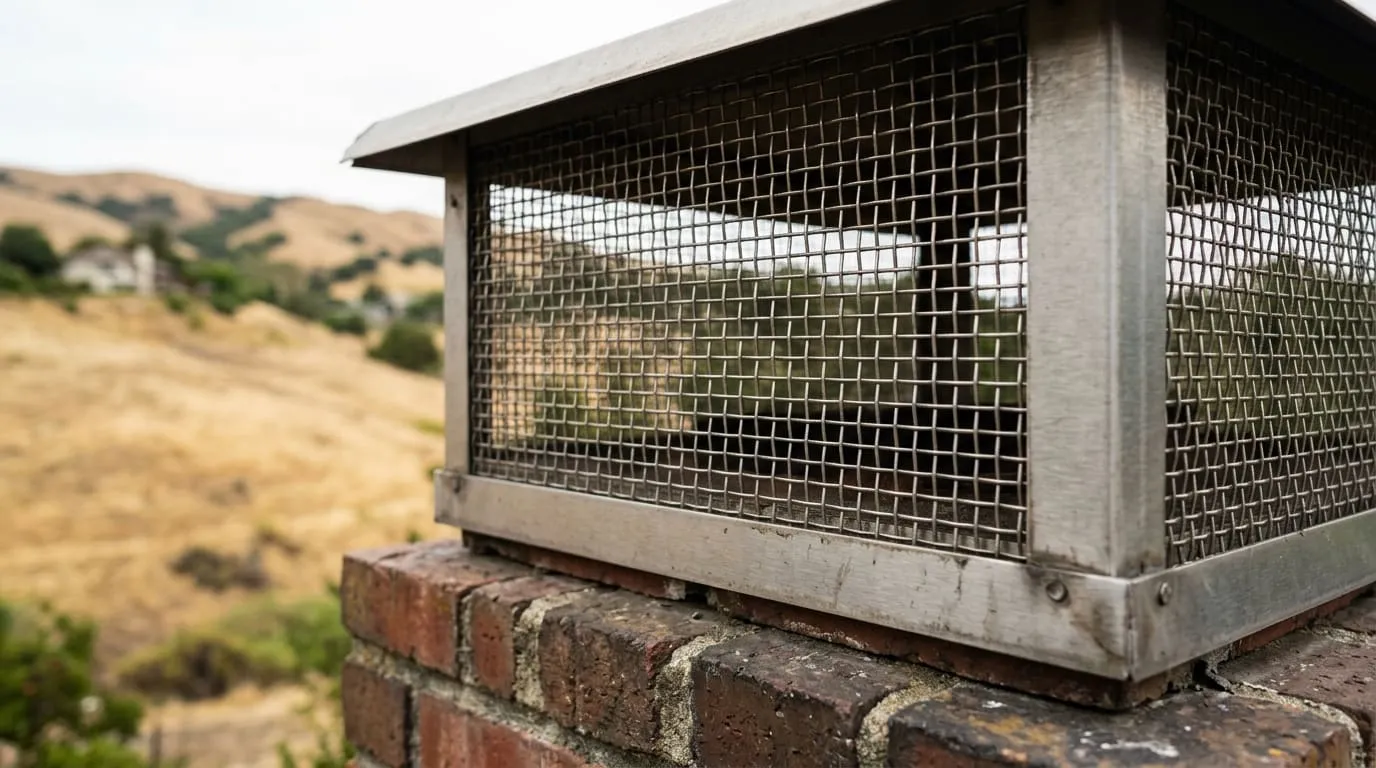
The same dry, gusty offshore winds that raise regional wildfire risk each fall put a chimney’s spark-arrestor cap under more real pressure than most homeowners realize. Here is what actually changes, and what to check before the season starts.
Every fall, usually starting sometime in September and running into November, the Bay Area sees stretches of dry, gusty offshore wind. Meteorologists and longtime residents alike call it Diablo winds, named for the Diablo Range the air masses often flow across on their way down from the interior. They are the same broad weather pattern behind Southern California’s better-known Santa Anas, and in the Santa Clara Valley they show up as unusually dry, warm, occasionally strong wind events at exactly the time of year vegetation is at its driest after a rainless summer. Regionally, they are the backdrop for the highest wildfire-risk stretch of the year. On a single-house level, they are also the moment a chimney’s spark arrestor earns whatever attention it got, or did not get, over the rest of the year.
What the spark arrestor is actually for
A chimney cap’s mesh screen, the spark arrestor, does two jobs continuously, but one of them matters disproportionately during Diablo wind conditions: it stops embers generated by an active fire inside the home from escaping up the flue and landing on a roof, in gutters, or in nearby dry vegetation. Under calm conditions a stray ember from a fireplace is a minor, largely theoretical risk. Under Diablo-wind conditions, with humidity low and wind pushing embers further and faster than they would otherwise travel, the same stray ember is a genuinely different hazard.
Why this is a bigger deal in the foothills and the Santa Cruz Mountains
Not every property in our service area sits equally close to wildland vegetation. A flat Sunnyvale or Milpitas tract lot, surrounded by other houses and landscaped yards, has a meaningfully different ember-exposure profile than a Los Gatos canyon home, a Saratoga foothill property, or anything in the Santa Cruz Mountains communities further out (Boulder Creek, Lompico, Brookdale, Ben Lomond) where dense forest sits close to the structure itself. That does not mean a valley-floor spark arrestor does not matter; it means a wildland-adjacent property’s arrestor condition and the defensible space immediately around the chimney deserve a closer look before wind season arrives.
What to check before fall arrives
A few things are worth confirming ahead of the season rather than after the first red-flag warning: whether the cap has a spark arrestor at all (some older installations skip it entirely), whether the mesh is intact and free of rust holes or gaps, and whether the mesh opening size is within the code range that stops embers without choking draft or trapping so much creosote that it clogs. None of these is a large job on its own, which is part of why it is easy to let slide; a spark arrestor is inexpensive equipment relative to almost anything else on the chimney, and it is disproportionately consequential when it fails at the wrong moment.
This is separate from Spare the Air restrictions
It is worth being clear that Diablo-wind season and BAAQMD’s winter Spare the Air wood-burning restrictions are two different things, on two different calendars, for two different reasons: Spare the Air targets wintertime particulate pollution from wood smoke, while Diablo winds are a fall wildfire-risk pattern related to ember intrusion, not smoke. A property can be well inside code on one and still need attention on the other.
Read next
More from the blog
Get a written scope, not a guess
We inspect first and put the repair in writing, with photos, and never give a number sight unseen.